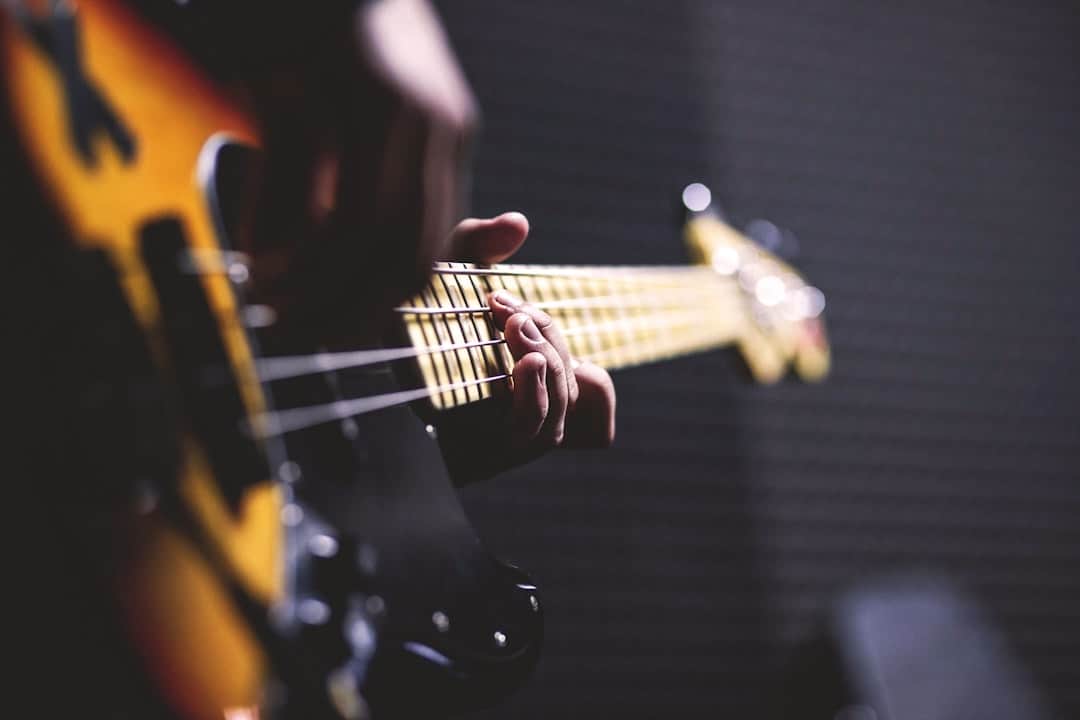
How To Play Bass Guitar
Beginner-friendly bass guides from Sheffield
I’ve been teaching bass for over twenty years, from total beginners picking up an instrument for the first time through to working musicians refining technique. This page is the start of a free bass guide I’m building — the things I find myself explaining most often in first lessons, written down properly.
If you’re brand new to the bass, the good news is this: it’s a forgiving instrument to start on. Four strings, no chords to worry about for a while, and a clear job to do in a band. You can be playing recognisable basslines within a few weeks if you practise sensibly. What you can’t do is skip the basics — and there are a few things almost everyone gets wrong without being told.
So let’s walk through what those are.
What you need to get started
You need a bass, an amp (or headphone amp), a cable, and a tuner. That's it.
For the bass itself, don't overthink it for your first instrument. A budget short-scale or medium-scale bass from a reputable brand — Squier, Yamaha, Sterling by Music Man, Ibanez — will get you a year or two of solid playing before you outgrow it. Avoid the £80 mystery-brand bundles from Amazon. The action is usually so high you can't fret notes properly, and that's a fast way to put yourself off the instrument before you've started.
For an amp, a 15-watt practice combo is plenty for home. If you're learning in a flat, a cheap headphone amp like a Vox amPlug or a multi-effects unit with a headphone out is kinder on the neighbours.
The cable matters less than you'd think for practice, but a tuner is essential. Use a clip-on tuner like a Snark, or any free phone app — just tune up every time you play.
How to hold the bass
This matters more than most beginners realise. Bad posture in the first three months will cause you problems for years.
Seated, the bass should sit on your right thigh (if you're right-handed) with the neck angled up at roughly 30 degrees from horizontal. The headstock should be at about eye level when you glance down. Both hands should reach their positions without your shoulders hunching.
Standing, set the strap so that the bass sits at exactly the same height as it did when you were seated. This is the single biggest mistake I see — people wear basses too low because it looks cool, then wonder why their fretting wrist hurts. Iconic stage poses are not worth carpal tunnel. Strap height matters; vanity doesn't.
If your wrist is bending sharply in either hand to play, the bass is in the wrong position. Adjust until you can play with both wrists straight.
The plucking hand
The fundamentals of plucking the bass are simpler than they look and harder than they sound. Two fingers (index and middle), alternating, anchored with the thumb resting on a pickup or string. The fingers pull across the string, not down into it, and follow through to land on the next string up — that’s where the rest position is.
This is one of those things that’s much easier to see than to read about. I’ve written a dedicated post on plucking that goes through it step by step, with the common mistakes and how to fix them: Bass guitar for beginners: plucking the bass. Or watch it in action in my bass technique lessons.
A few things worth knowing now, though:
Anchor your thumb on the pickup, not floating. Floating thumb is a technique you’ll learn later; start anchored.
Alternate i-m-i-m strictly. Don’t get into the habit of playing repeated notes with the same finger — it’ll throttle your speed forever.
Stay relaxed. Tense plucking sounds tense. The hand should feel light.
If you’re a guitarist already and you’re tempted to use a pick — yes, you can, plenty of bass players do (Carol Kaye, Paul McCartney, half of pop history). But learn fingers first. The instrument gives you so much more tonally with fingers, and you can always pick up a pick later.
The fretting hand
The fretting hand position is dictated by one rule: one finger per fret. Index finger on the first fret of any given position, middle on the second, ring on the third, pinky on the fourth. This is called "1-2-3-4" position and it's the foundation of everything.
Your thumb stays behind the neck, roughly opposite your second finger. Not wrapped over the top — that's a guitar habit — and not below. Behind. The neck sits in the U of your thumb-and-index, with space underneath.
Press the strings down with the tips of your fingers, just behind the fret (not on it, not way back from it). If you press in the middle of two frets, the note buzzes; if you press right on the fret, you mute it. Just behind, every time.
Pinky strength is what separates intermediate bassists from beginners. From day one, use the pinky. Don't substitute the ring finger for fourth-fret notes because the pinky feels weak — that's exactly how it stays weak.
Your first notes
Tune the bass to standard tuning: E, A, D, G, from lowest (thickest) to highest (thinnest). With it tuned, the lowest open string is E.
A good first exercise: play E (open string) for four beats, then F (first fret, same string) for four beats, then F# (second fret) for four beats, then G (third fret) for four beats. Use the i-m-i-m alternating pattern with the plucking hand and 1-2-3-4 with the fretting hand. Repeat slowly with a metronome at 60 BPM.
That's already most of what you need to start learning real basslines. A lot of pop and rock songs use a handful of notes in a handful of patterns. Once you can fret cleanly and pluck evenly at 60 BPM, you can play a lot of music.
Reading bass tab
Bass tab (tablature) is the most beginner-friendly notation. Four lines represent the four strings — G on top, E on bottom, looking down at the bass — with numbers on the lines telling you which fret to press.
G|---------------------|
D|---------------------|
A|---0-2-3-------------|
E|---------------------|
That reads as: open A string, second fret of A, third fret of A — which is the notes A, B, C.
Tab tells you what to play but not how long to play it for. That’s its big limitation — you have to either know the song already or read tab alongside listening to the recording. Standard notation handles rhythm properly, and we’ll get there in time, but tab is fine for now.
How to practise properly
Twenty minutes a day, every day, beats two hours once a week. The bass is a physical instrument and your hands need consistent reinforcement to build the patterns.
A good twenty minutes looks like:
5 minutes warm-up. 1-2-3-4 exercises up and down the neck, slowly, with a metronome.
10 minutes on whatever you’re learning. A scale, a bassline, a song.
5 minutes free playing. Improvise over a backing track, or just mess about with what you’ve learnt.
Slow practice is fast progress. If you can’t play something cleanly at 60 BPM, you can’t play it at 120 — you can just play it badly faster. Use a metronome for everything until clean playing at a slow tempo is your default.
One more thing: record yourself occasionally. You’ll hear things in a recording that you can’t hear while you’re playing. It’s uncomfortable the first few times. Do it anyway.
Common questions
How long does it take to learn bass?
You'll be playing recognisable basslines within a few weeks. You'll be a confident beginner within six months of consistent practice. "Mastery" is a longer conversation and an open-ended one — there's always more.
Is bass easier than guitar?
The first steps are gentler — no chord shapes to learn. The deeper you go, the more there is. Both instruments are infinitely deep; the bass just lets you make music sooner.
Do I need to read music to play bass?
Not to start, no. Tab will get you through your first year. Standard notation opens up a lot more material later and is worth learning eventually, but you don't need it on day one.
Can I learn bass online?
Yes, with discipline. The plucking-hand and fretting-hand technique is the bit that benefits most from a teacher watching you in real time — bad habits are very hard to unlearn.If you’re going to learn online, get someone to watch your technique periodically, even just with bass guitar lessons over Zoom.
Where to go from here
This page is the start, not the finish. If you want to keep going:
The plucking the bass post covers the plucking hand in proper detail.
The free bass lessons on my Videos page cover technique step by step, plus song tutorials with on-screen tab, all from the Slap’n’Pop YouTube channel.
If you’d rather have someone teach you directly — in Sheffield or online — that’s what I do. Bass guitar lessons for in-person at the studio or over Zoom, or get in touch if you’ve got a question first.
There’s no rush. Bass is one of the rare instruments where the absolute beginner and the touring pro are doing fundamentally the same job: playing the right notes at the right time, locked in with the drummer. Get the basics right and the rest builds on top.
Latest guides
Free guides for bass beginners — more posts as I write them.